A Sermon for the Fifth Sunday of Easter, Year A – John 14:1-14
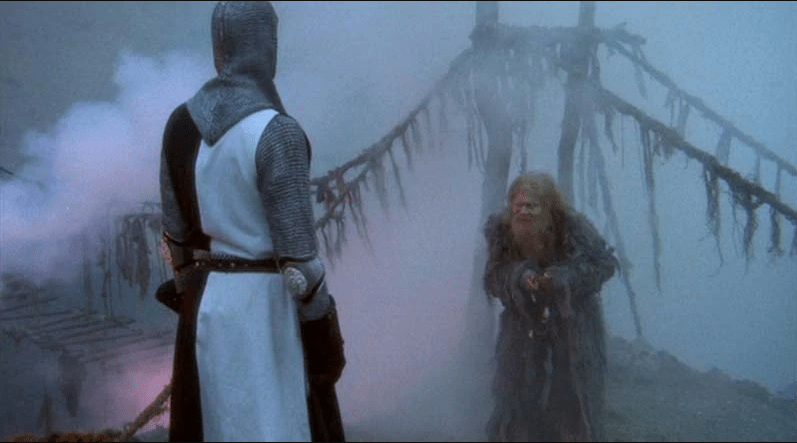
How many of you are Monty Python fans? Did any of you watch the film “Monty Python and the Holy Grail”? It is, to paraphrase the film itself “a silly [film]” but it has some memorable scenes. One of them is towards the end, as King Arthur and his four remaining knights approach Castle Aaargh, where, according to an inscription left by Joseph of Arimathea, the Holy Grail is to be found.
But before they can get to the famed Castle Aaargh, they must pass over the terrifying Bridge of Death, which is guarded by an all-powerful soothsayer. If they answer his questions wrongly, they are cast into the terrifying Gorge of Eternal Peril.
One of the underlying assumptions of Monty Python is that life is completely absurd. Not just in the sense of being funny, but in the bleak, post-modern sense that nothing means anything, everything is just random- just one damn thing following the other. You can see that fundamental sense of the world at work in all aspects of their films and TV series, where events follow one another without any sense, where jokes are unexpectedly terminated, where nothing coheres.
So it is that the dread soothsayer of the Bridge of Death asks questions which seem to be completely random. What is your favourite colour? He asks Lancelot, the first across the bridge three questions. What is your name? What is your quest? And what…. Is your favourite colour?” Lancelot answers correctly (his favourite colour is blue, which he correctly names.) The second knight, Sir Robin, is not so lucky. His first two questions are the same, but his second is harder: What is the capital of Assyria? He cannot answer, so he is cast into the Gorge of Eternal Peril. There’s no rhyme or reason to it, the questions don’t really lead anywhere much, they aren’t profound or significant. They are just arbitrary and ridiculous. I won’t spoil the story by telling you the fate of the final two knights or of Arthur himself. If you are curious, feel free to ask me after the service.
So, the reason I bring all this up, apart form my enjoyment of Monty Python, is that I think that is the sort of vision of Jesus which is operative a lot of the time when we say that Jesus is the way to the Father. We hear it as: if you want to get to the Father, you are going to have to get through me first. We think of him as standing on the Bridge of Death demanding impossible answers to stupid questions about arbitrary theological minutiae and hurling anyone who gets the answers wrong into the Gorge of Eternal Peril.
However, much as I enjoy a good Monty Python reference, the embedded philosophy underneath it is problematic. While I don’t know what they believe at a personal level, the operative philosophy of their comedy is that life is absurd. Event follows event, but they have no necessary connection to one another, and there is no unifying meaning at the centre of it all. That’s why the all-wise soothsayer on the Bridge of Death asks such stupid questions – some trivially easy, some extremely difficult, all completely random. An arbitrary universe can’t have meaningful truths at the centre. It is inherently nihilist. It’s a philosophy for clever undergraduates, but it isn’t one that you can live a whole life by.
Or, at least, a not a satisfying one, or a very long one.
Perhaps we could see the Gorge of Eternal Peril as being all too real. At the centre of our post-modern culture there is an impassible barrier, on the other side of which is a life of meaning and purpose, symbolised by the Holy Grail. But we can never pass, because standing in the way is the inhuman, impersonal, absurd universe. Perhaps there is a purpose to the universe, but it is not one we could ever understand or access. So, better then to hang around on this side and mock anyone who tries to cross it.
But what if that whole idea is just false? What if there is a profoundly meaningful way to live, which bridges the Gorge of Eternal Peril, not by overcoming the absurd questions of a comedy soothsayer, but by addressing the real, existential questions which define life for all of us?
There is a basic theological claim which forms a bridge between the comic nihilism of Monty Python and Christianity, which is this: Jesus says “no-one has ever seen God.” Or, in a more theological form, no-one knows God in God’s essence.
No-one has unmediated knowledge of God. God is so radically unlike anything in our experience, so unlike anything in the universe, that any words we speak about God are going to be not true, because they are inadequate to the task of describing God.
So, when we say that God is our father, we say that knowing that God is not in fact our literal father, a man who might still be walking around and whose name we are likely to know. Instead, we are saying that our relationship to God is like that of a child to a father – dependence, care, one being necessary for the existence of the other. There’s a lot we could say about this relationship, but we know it is a metaphor. So is the idea of God being King, or a judge, or anything else we could say about God. They point to an aspect of how God relates to us, but they don’t contain the whole truth about God.
“God is always greater” is a good tag for this idea. God is always greater than any sentence we say about God. God is always greater than any idea we have about God.
So perhaps we should just stop there? Perhaps God is just this un-nameable, incomprehensible, impossible to describe “something out there”? Like the twentieth century philosopher Ludwig Wittgenstein said: whereof we cannot speak, thereof we must remain silent?
But that is a profoundly unsatisfying answer. How is a God about which one must remain silent different from no God at all? Is that all we can hope for – celestial clock-maker, or perhaps the universal hacker, of Deism?
The odd thing about the Christian tradition is that, while it definitely embraces the idea that “God is always greater”, it makes the surprising claim that God not only exists but actively wants to reach out to us. The way we think God does that is through God’s actions in history, which has a focus point in God’s definitive action in the life, death, and resurrection of Jesus Christ.
This is what it means for Jesus to say that whoever has seen him has seen the Father. Jesus answers the question: if God were a human being, what would that person be like?
So far we have been thinking about this question as though we were in a philosophy seminar, and we had nothing more to worry about than the quite interesting, rather abstract, question of whether there is a “supreme being” and, if so, what that being might be like. It as though, as I so often seem to say, it is nothing more than a neutral question about facts – like, for instance, the date of the Battle of Actium. A nice, safe conversation, where we sit comfortably in judgement over various ideas and opinions about God, which leaves us in control.
But what if God is not just passively sitting up in the sky, waiting for our approval? What if this God, this creator of all things, wants something from us, in fact wants everything from us – wants us as such?
If so, then what might it be? What does this God want from us? All the created order just kind of does its thing – the bees buzz and make their honey, whales sing in the oceans, the stars and galaxies perform their minuet in the incomprehensible vastness of time and space, and none of them have any real choice in the matter. None are morally responsible. When a cyclone kills a thousand people, we don’t hold the cyclone to account. If a person kills someone, we do.
The created order praises God just by existing. But just as it is in the nature of the stars to convert hydrogen to helium, heat, and light, so it is in our nature to be morally responsible individuals, answerable to one another, and, ultimately, to God.
Which is why it is so urgent to know what God is like. For us to do our best to work out what God wants from us, and then to do it. Because that is what it means to be a human. That is what sets us apart from the rest of creation.
But that makes it sound like Christianity is being a good person, and that the whole drama of sin and redemption is just that people don’t know how to live, and all that we need is better information. But, in fact, even when we know what to do, we fail to do it.
What we fundamentally need is not more or better information, but to be transformed into the sort of people who can actually live a good life.
What Christianity has at the centre is Jesus, and Jesus not only shows us who God is, but is, in some multi-dimensional sense, the Way to God.
I talked about the Mandalorian before, and the centrality of “the way” to being one. For them it seems very tied to the liturgical use of armour, which looks cool on TV, but also, I think, has at its heart a kind of at least ethical seriousness.
Though perhaps I am expecting too much from a series about a sci fi cross between a cowboy and a samurai.
The point, though, is that when Jesus shows us the Father, it isn’t just passive information which we can just absorb and then go about our day. It is something much more existential than that. It is, in fact, much more like being a Mandalorian and, as Paul puts it, putting on the whole armour of God.
Jesus summons us to join him on The Way – which is, in another sense, Jesus himself. It’s good to be a morally responsible person, but all of us fall short, and it isn’t quite the point. Jesus doesn’t, as a rule, tell people to be better – they already know they should be better. Rather, he talks about the Kingdom of God, which is like buried treasure, like a pearl of great price, like a wayward child returning to a loving parent.
We don’t come to God through knowing facts about God. We reach God by, somehow, being bound up in Christ. That, somehow, through Jesus, God acts decisively in human history, and, in raising Jesus up, raises us all up. And that this is the act of God, not from any goodness of our own.
God joins us into the great meaning behind the whole universe. The fundamental fact about the Bridge of Death and the Gorge of Eternal Peril is that what confronts us there is not the absurd soothsayer with his nonsense questions. Rather, Jesus stands there, and beckons us to join him on the Way that leads to God.


