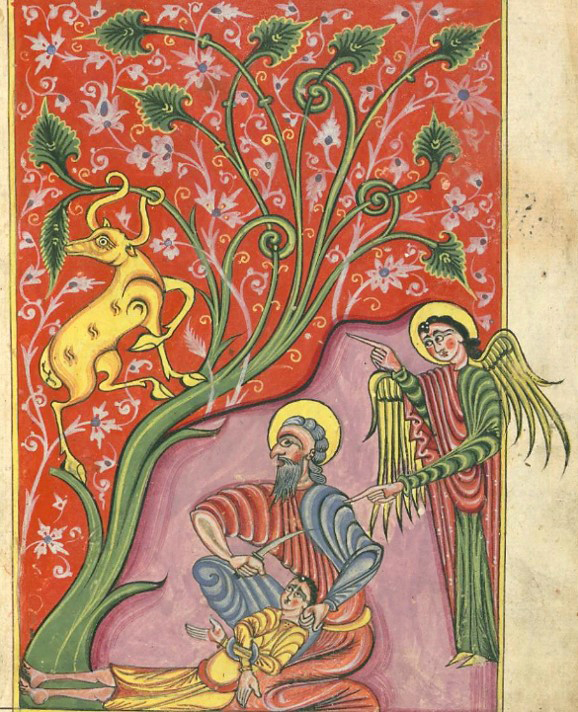
A Sermon preached for Carlton Church of All Nations on 28/6/26 on Genesis 22:1-14 Year A Proper 8 (13) Fifth Sunday After Pentecost
One way of thinking about Christianity it that it is a recipe for a better life. You don’t need to be a full-on advocate of prosperity theology to think that getting your life sorted out and getting right with God is the way to a sensible, middle-class standard of living. For a lot of people, the only way out of the chaos of their lives has been through Christian faith. And to get off the drugs and the booze and stop wasting your money on the pokies and start getting up on time and holdi ng down a sensible job is, in fact, both good advice, and a possible outcome for becoming a Christian.
God’s word of grace and forgiveness offered into a life distorted by sin can be a moment of profound transformation for people.
But there is another level to the life of faith where it isn’t so straightforward. Where the attempt to live by God’s rules is not resulting in a good life, or at least not the version of the good life you were expecting. What does it mean to be Jesus’ disciple when it suddenly doesn’t seem to work?
What does it mean to trust in God when our life is suddenly upended and it’s like we have lost our way in the bush in winter and the sun is vanishing over the horizon?
Abraham’s situation in this story is like that. Only worse.
One day, late in Abraham’s famously long life, God said to him: get up and go. Take your only son, Isaac, who you love, and offer him to me as a burnt sacrifice in the land of Moriah on a mountain I will show you.
Firstly, a few textual things. Our translation hides it, but the way God summons Abraham to this shocking adventure – “Get up and go!” – is the same word God summons Abram out of Haran. The Hebrew term[1] is lek leka, which is only used by God to Abraham in these two instances.
This passage is also basically the end of the Abraham cycle in Genesis: Abraham is reaching the end of his life, and making arrangements to bury Sarah and release his responsibilities to the next generation, and so the story soon changes focus to Isaac.
Thus we can see this episode as the culmination of Abraham’s story of faith, mirroring his initial call from God after all those adventures. But it is being echoed, of course, in a significantly darker key.
Historically this story must be the echo of a time where human sacrifice was practiced by our ancestors. Certainly, it has been widespread in human culture, almost certainly including Israel’s neighbours. After all, the logic of sacrifice is that the more valuable the gift, the more the god in question will be inclined to hear your request – and so for really big issues, like wars or failed harvests, the most valuable, the most shocking, gifts might be expected to have the most effect.
In which case, God’s provision of a ram instead can be seen as God putting an end to all that sort of thing, leading to the various verses in Scripture forbidding human sacrifice in general and child sacrifice in particular[2].
So, let’s think about Abraham’s dilemma.
He was being asked to sacrifice his son – the one on whom his hope for a future rested. The one who had been miraculously granted to him and Sarah, the direct result of God’s promise to them.
So, Abraham has a dilemma, to say the least. Surely, when he thinks God is calling him to this terrible thing, he should do the natural human, moral, thing, and say: no way am I going to sacrifice my son. But his whole life is devoted to faith in the one who called him up out of Haran, the one who said to him “get up and go.” Can he now renege on that faith? The faith which gifted him Isaac in the first place? The act of faith upon which his whole life rests?
One possible reading of this passage is to say that the point is that, if you think God is asking something terrible from you, to go and discuss it with wise people. I think that sounds like very good advice. There is a long tradition of Christian discernment to help people think about whether they have, in fact, heard from God. I think it is pretty clear that God does not go about asking people to sacrifice their children, and if you think he is, then you are definitely mistaken.
That’s good advice, as far as it goes. We believe that “the holy” and “the good” are, ultimately, one and the same thing. We don’t think that God would ever require something morally wrong from us. We believe this because of the way God revealed Godself in Jesus Christ and his life, death, and resurrection.
However, there is more than one way in which God asks something of us. Another way, a powerful way, is when life itself seems to demand something from you, something more than you can stand.
For instance, when Anne and I were deep in our infertility journey, when the incredibly basic human drive to have children was being denied to us, what was life asking of us? How were we to when the external evidence of our lives made us question God’s love for us? Whether, at the most fundamental level, whether the universe as such was a welcoming place for us, whether God was “for” us?
When you do all the right things, when you live in the way you think God wants of you – and things still don’t work out – what then?
They say that being betrayed by someone close to you is far worse than a natural calamity. It would make sense that we have a degree of natural resilience to terrible things happening in the world around us. After all, terrible things happen to people all the time, but, the next day, we have to get up and dust ourselves off and get on with life. After all, what’s the alternative?
But when someone close to you betrays you – that is something else entirely.
In the God Delusion, you can see that the famously atheistic writer Richard Dawkins is quite shocked by some of the unedifying stories in Scripture. But no matter how much Professor Dawkins and his ilk think they are shocked by this passage, I am more shocked. That is because, for the atheist, God is more like a scientific hypothesis to be proved or disproved, like some esoteric idea about sub-atomic particles.
But to believe in God like Abraham does, like we are called to, is not just to have some opinion about God’s existence or not – it goes much, much deeper than that. It is to believe in your gut, right down in the core of yourself, the wellspring of your life, below any level of conscious decision-making, that God is for you. To believe that “if God be for us, then who can be against us?”[3]
To have that core belief, that foundational trust towards the world, shaken – that’s not like some theory about particles. It’s more like being betrayed by a close friend. It’s like Jesus being betrayed by Judas and abandoned by his friends.
It is like being Abraham confronted by the divine command to sacrifice his son. The whole framework of his life is upended, and he does not know which way to turn.
To some of us, Abraham’s situation, at the extreme edges of human experience, can seem remote. Where the implicit bargain of “play by the rules and things will go well with you” seems to have paid off of us. Where we don’t spend much time at the margins of our faith, and stories like this can seem overblown, even histrionic. Which is, of course, a in many ways a good thing – who would want to trade places with Abraham? Not to mention Isaac?
But when we find ourselves here, at the extinction of all human hope – what possible Good News could there be?
For Abraham and Isaac, of course, there was a happy ending. A deus machina. God provided a ram as a sacrifice instead of Isaac and praised him for his faith. Of course, that just makes the text even more disturbing, and I don’t want to try to wrap it up in a nice bow.
But that’s just like life isn’t it? Life does not always resolve itself so neatly. The loved one dies. The betrayal is all too real. The thing you were dreading beyond words has come to pass. What then?
One of my favourite thinkers is Victor Frankl, who wrote a profound account of his time in Auschwitz, entitled Man’s Search for Meaning. He notes that it was the people who had given up on the meaning of life, the ones who had abandoned hope, who died. We are used to the idea that the camps killed faith, but, in fact, it was faith which kept people going. He wrote that the one who has a “why” can survived any “how.”
One of the strange things about those horrible five years of infertility and all the rest of the awful things that happened to us, was that I actually felt a lot more in touch with God than I generally do. It was as though everything inessential had been burned away and only what was most deeply true was of any importance to me.
I felt like I had died, but was still walking about.
I felt like the experience put me in touch with something of fundamental importance, and I came out of it profoundly changed.
It was only through Abraham’s faith that he could survive – and indeed thrive. Only through faith did he leave his father’s home in Haran, only through faith was he able to be part of God’s reconciling mission to the world. Only through faith, refined through the fire of suffering. Proved in the furnace of life.
In good times, and in bad, the life that comes from faith in God is the only one which leads us to the source of all life and comfort, the only life which puts us in touch with God, the only life that which is worth living in the first place. Because, in the final analysis, only the God who raised Jesus Christ from the dead is ultimately faithful, and completely worthy of our trust.
To the holy, blessed and glorious Trinity,
three persons and one God,
be all glory and praise, dominion and power,
now and forever.
Amen.
[1] I’m drawing on Howard Wallace’s resource here. I have as close to zero Hebrew as makes no difference.
[2] See for example Leviticus 18:21
[3] Romans 8:31


