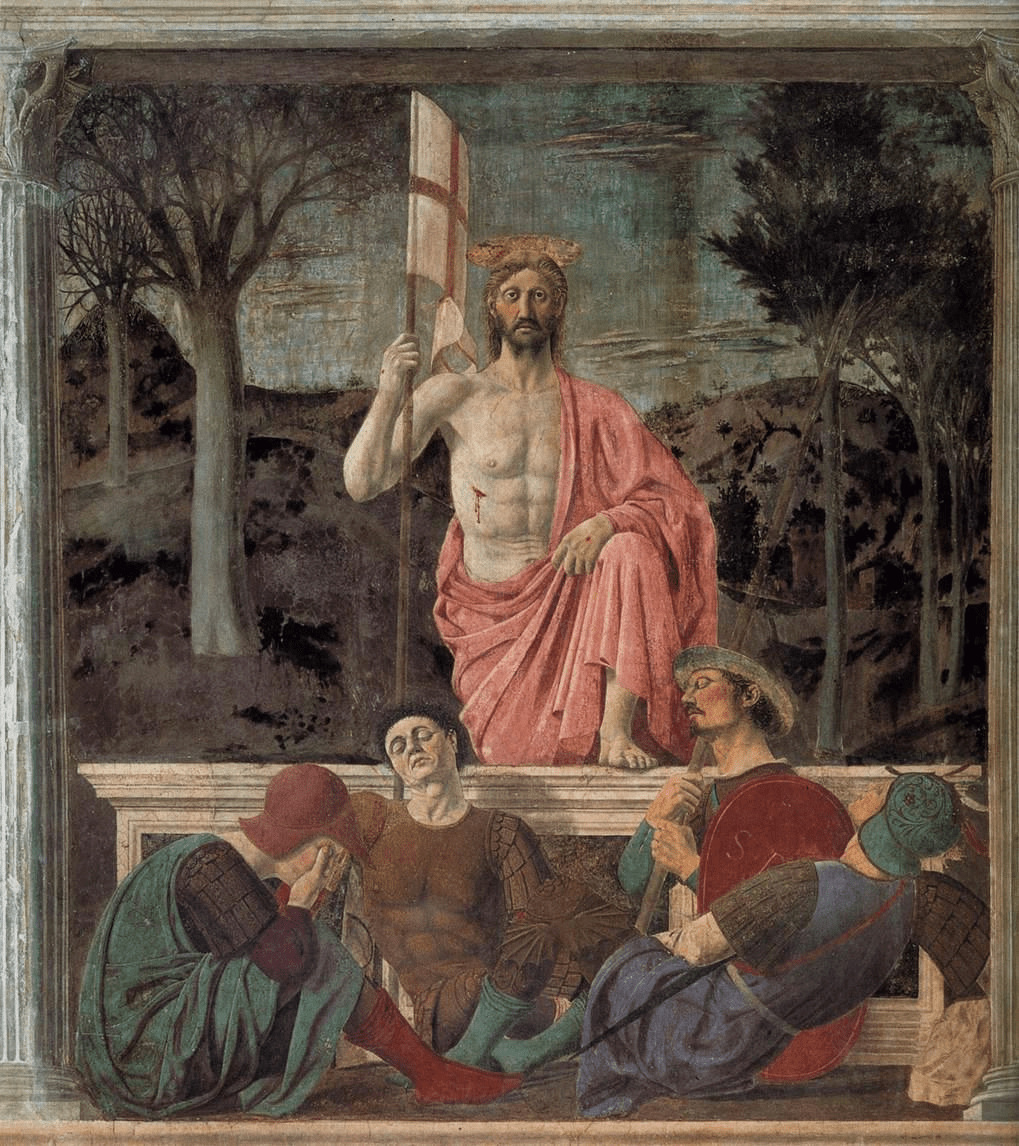
A Sermon for Easter Day – Year A – Matthew 28:1-10
It is a bit of a commonplace among some science-y types that humans are insignificant in comparison to the universe and all the many things in it. They love to point out how small humans are, how a brief a human life is, in comparison to the astonishing vastness of the universe and the unfathomable depths of time. They look at a supernova or a black hole, or a galactic cluster on the one hand and say: look at the sheer scale of that! And then they look at humans who are so fragile and brief, and go, and look how small we are! How insignificant!
They see a universe which seems to operate in regular ways which we can predict using mathematical models and see something much more like a giant machine which grinds inexorably on, regardless of human wants or intentions. Things have measurable effects on other things, and that’s it.
They look at the vast scope of the universe on the one hand and the brevity of human life on the other and conclude that humanity is a sort of side effect of something much more important. It is a picture of a world without God, except, perhaps, as a kind of celestial clockmaker, or a hacker who set the initial parameters for the simulation going.
Regardless, it is a world in which humans don’t matter. They are irrelevant to the great machine of the universe, in which we are alone under an infinite sky. No God, no good, no evil, no meaning except that which we can make up to keep ourselves entertained for our brief moment of consciousness.
If consciousness itself really exists, which is a pretty hard thing to believe in from the perspective of science.
In our secular age, we are just insignificant nothings, doing nothing of any importance, none of which matters.
And, thus, no particular reason why human life might have any dignity. No particular reason why not to amass as much wealth and power and pleasure as possible. And I suspect, any suspicion that might not be a good way to live is just the motor of our civilisation running on the fumes of Christianity.
Of course, humans have always known how very small they were in comparison to the universe as a whole: “all flesh is grass”, and “a thousand ages in thy sight are like an evening gone”, as Scripture says. But the secular age of which we are a part marks a step-change, a new level of felt intensity in this knowledge.
But, when you think about it, the idea that any one thing in the universe is somehow more “significant” than any other is odd, from the perspective of science. As we said earlier, things have effects on other things, which we can model more or less precisely using mathematical models, and that is an end of it. Some things are bigger, some things are smaller, some effect more things than others, but there isn’t any way in which they can be said to be in any way “more significant” than one another.
After all, we don’t have a general theory which says that big things are more important than small things, which we then scale up to the size of a universe. We don’t think that an adult is more important than a child because they are bigger. If a tree falls on a child, we don’t shrug it off because the tree is more important because it is bigger.
In fact, we could just as well argue that given that, as far as we know, only humans are in a position to define things as “significant”, it is in fact humans who are significant, and all that dead matter floating around in space is nothing but an unimportant backdrop to our lives, albeit one which goes on for a lot longer.
As C.S. Lewis noted, the problem is that scientists are incurable romantics. At some hard to determine point, size stops being mere extension and becomes a quality all of its own. It stops merely having a certain size and becomes “sublime.” And, at that point, they stop being scientists, concerned purely with measurement and prediction, and become, like the rest of us, story tellers. Myth makers. Believers.
And the myth of the godless universe flaring up into existence and then fading out, has a certain chilly majesty, great imaginative and emotional power. It makes us the tragic heroes of this drama, finally seeing the truth about this empty universe, and bravely facing up to the reality of the universe.
But, in fact, it is a myth. A way of understanding the universe in which we find ourselves, but it is not the necessary consequence of doing science, and there are piles of scientists who don’t buy it.
A lot of debate about Christianity focuses on the reality of the resurrection of Jesus. Did it actually happen? That’s what we would like to know. And, ideally, we would like to know with the sort of certainty which we apply to doing things like sending Artemis II on its voyage around the moon. We would like it to fit into one of our elegant mathematical models of the universe.
Unfortunately, this level of certainty isn’t available to us, which is a problem to us, because we like science, because we like certainty and safety and control, and the resurrection is none of these things.
To ground it in our text for today: the life of Jesus without the resurrection is not good news. A good man who healed and taught and showed a new way of living is taken up by the authorities and executed as a threat to good social order and that’s it, is not good news. It is not even news – just yet another just person murdered by the unjust as the stars above us perform their ancient dance and the furnace of the sun keeps burning and nothing matters.
But the point of today’s sermon, today’s service, is the astonishing Christian claim that Jesus did, in fact, rise from the dead.
I want to start by making two points.
Firstly, there is a famous sceptical dictum that “dead people don’t rise.” Well, certainly it isn’t common. But the reason we have “scientists” rather than just “science” is that we do not in fact know all the “science.” It is perfectly reasonable to wonder whether God, having made the universe, might not have left Godself ways to engage with it. The laws of science, after all, are not the same as the laws of logic[1] – we just notice that things tend to happen in predictable ways.
Our feelings about the relative likelihood of Jesus’ resurrection are not an especially solid guide for decision making. Who knows what God would be capable of? We don’t have anything else to compare it to. We have no “rational” way to make a final decision, because science, while it can point out how surprising, how unlikely it all is, we kind of already knew that.
All we have is a sense of what God might, or might not, do. And that really depends on the story which we inhabit. If we inhabit the story of a dead universe in which the stars and atoms and whatever do their thing and that’s the whole story, then of course we will find the story of the resurrection hard to believe. But, as we have already said, the reasons to inhabit that story as the whole truth are not particularly strong.
My point is not to prove that it happened, but, rather, to open the door to it. Belief in the resurrection of Jesus is not irrational, whatever else it might be.
Secondly, it seems pretty obvious that Matthew’s account of the story is very keen to emphasise that the women really saw Jesus’ physical body. It was not a ghost, or some other sort of apparition. That is part of the point that he is making by saying that “they took hold of his feet.” Ghosts don’t have feet you can hold onto.
Whatever Matthew is saying, it really doesn’t sound like an account of people gradually coming to faith in a renewed faith in Jesus. He really does seem to be saying that on Friday these women saw Jesus laid in a tomb – a fresh tomb so that there was no possibility of getting confused – and on Sunday morning they went back to the tomb, and, instead of a sealed tomb, they saw – well, something amazing.
It was obviously a category-shaking event to everyone involved. The different accounts are quite different from each other. Whatever it was, it led all the Apostles bar one to be horribly martyred for their belief in Jesus and his resurrection, so they were scarcely likely to have made it up.
But, important as the reality of the resurrection is, to talk about it purely at this level is to miss the point. The point is not exactly whether you could have visited the empty tomb had you been on a holiday in Jerusalem in AD 33.
The point is: What does it mean? What did it mean then, and, perhaps even more crucially, what does it mean for us, here and now?
The resurrection of Jesus is not an historical point which we can reach at the end of a long chain of reasoning, as though we are historians judiciously approving of a new theory about the exact date of the Battle of Actium.
The resurrection of Jesus isn’t something for having opinions about. It is something you prove the truth of through a whole life. It is an invitation to a whole new way of seeing God – to be “transformed by the renewing of our minds.”
The invitation of Easter is to allow God in. To open our minds, and our hearts, to the idea that the observable physical movements of objects in space is not all there is. That our human lives are not irrelevant to the big story. That the best way to live is not to amass wealth and power and pleasure and devil take the hindmost. That, in fact, whatever God is doing with this amazing universe, God has a place for us. That our sin and our shame is not something a remote God observes from a safe vantage point in his lab.
Rather, in Jesus Christ, God comes into our lives and takes the whole weight of our sin and shame and failure, and in complete solidarity with us, does what we ourselves could not do, and makes us right with God.
More that, the promise of the Resurrection is, as Paul puts it, God has raised us all up and “your life is hidden with Christ.” It is not just a fact about history: it is a fact about us, or at least it can be a fact about us, if only we place our ultimate trust in the God who raised Jesus from the dead.
The God who raised Jesus Christ from the dead offers us a life of meaning and significance. A story in which we are not the great existential heroes of the myth of scientism, but, rather the children of a loving God, who is the author of all things, the redeemer of all things, and the one who is bringing all things into fulfilment. We may be small, but because of the great love that God has for us, individually, specifically, and by name, we are of great significance. Every single one of us.
As the angel said to the women, as Jesus says to all of us: Do not be afraid.
[1] This is pure Hume. See https://iep.utm.edu/hume-causation/

 Alister Pate