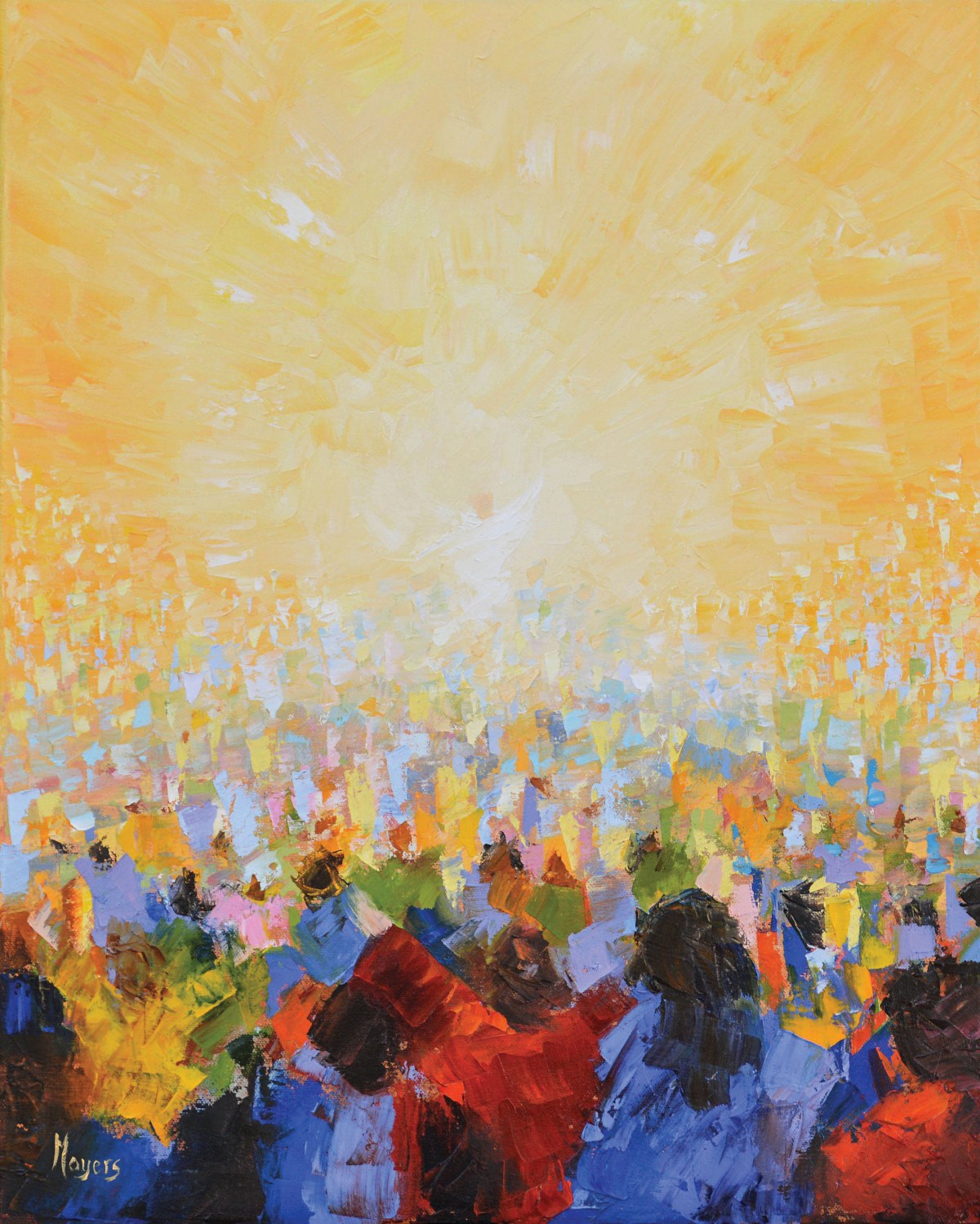
A Sermon for Palm Sunday / Liturgy of the Palms Year A – Matthew 21:1-11
Martial arts expert, Hollywood actor, and internet favourite Chuck Norris died last week, which feels strangely timely for the topic of Palm Sunday. I know that sounds like a bit of a long stretch, but I promise you that there is a point here, beyond Norris’s outspoken Christianity.
Specifically, he was the basis of an endearing family of internet memes, known as “Chuck Norris Facts,”
For instance: when Chuck Norris was filming in the jungle, he was bitten by a cobra. Five agonising days later, the snake died.
Again: how many push ups can Chuck Norris do? All of them.
And finally: they tried to put Chuck Norris’s face on Mount Rushmore, but the granite wasn’t tough enough for his beard.
Apparently, this last one was his personal favourite “fact.”
I thought about Chuck Norris at church on Tuesday because we were talking about Matthew’s account of Jesus’ triumphal procession into Jerusalem, and several of us noticed that in this version of the story, Jesus rides two donkeys simultaneously.
And this made us think of the famous ad where an action hero does the splits between two Volvo trucks. Unfortunately, when I googled it, it turned out that the action hero in question was Jean Claude van Damme. However, I did also find a one-upping video showing Chuck Norris doing the splits between two jet airliners with a dozen sky diveres standing on his head, making the outline of a Christmas Tree. Which, I guess, is a kind of “Chuck Norris Fact” all of its own.
However, perhaps I digress.
Is Matthew’s point to portray Jesus as a sort of superhero? Is he saying that only the true King of Israel could ride two donkeys simultaneously? Is this similar to the legend of King Arthur where only the true king of England could pull the sword out of the stone?
Why, in short, does Jesus need to ride two donkeys?
Let’s take a short break from talking about Chuck Norris and take a look at the story in a bit more detail.
Firstly, an interesting textual thing. The passage says that the people in Jerusalem were “in turmoil”, but apparently the word used is related to the word for an earthquake, so the image we are looking for is that of the whole city, and everyone in it, swaying, cracking, and scrambling for secure footing under the shock of his earth-shaking event.
Another wondering that people had was about the ownership and borrowing of the donkeys. I think we can probably assume that Jesus had made some sort of prior arrangements, because the people at the time would have been about as keen on some random passer-by co-opting their donkeys as you or I would be.
OK, what about the palm branches waving and the cloaks thrown on the ground for Jeus and his donkeys to walk on? These go to the heart of what the crowd thought was going on, which is that they thought, or at least hoped, that Jesus was coming to restore the Jewish nation to freedom. To drive out the hated Romans, and the Hasmonean dynasty of Herod and his cronies, who were even worse because at least the Romans weren’t pretending to be proper Jews, but Herod and his mates certainly were. At last, a true leader, who was worth getting behind! So people throw their cloaks on the road because it is the least they could do, because if you are prepared to sacrifice your cloak for the cause, you are probably prepared to fight for it.
All these things point to Jesus’ kingship. They do that in two ways: a surface, literal way, and a deeper, ironic, darker way.
Let me jump back in the story of Jesus’ ministry, way back to the beginning when the Holy Spirit drove him out to the wilderness to face Satan, the Accuser, the Great Adversary. He faced, as you will recall, three temptations: to turn stones into bread; to swan dive off the great Temple in Jerusalem so that the angels would save him; and to rule over the whole world, if only he would worship the Adversary.
We tend to think of that episode as just being one of the various things that Jesus did during his ministry. A trial he had to overcome and then it was over and done with. I wonder if a better way to think about the temptations as being always present to Jesus, because they were built into the structure of his life an ministry.
It must have always been a temptation to wave his hand and solve people’s problems. But the point of Jesus’ miracles was not to be kind of public service provider, a sort of divinely appointed NGO, but to reveal God to people and summon then back to him.
He must have often longed to short circuit all the tedious doubts and annoying misunderstandings and his disciples’ faintheartedness by doing something truly spectacular to make them believe.
And, riding into Jerusalem with the crowd behind him shouting “hosana to the Son of David”, even if it did not occur to him to do what the people wanted him to do, it was structurally open to him to do it. He was God’s son, and if he chose to drive out the Romans and Herod and all the rest, then nothing could stand in his way.
That’s how the story was more or less supposed to go. Think about all those pictures of the national liberator, the new father of his nation, riding into the capital on a jeep, rifle slung jauntily across his shoulder, his loyal lieutenants up there with him.
That’s why those posters of Che Guevara look a lot like Jesus.
But, as exciting as that would all be, as gratifying to the film maker and the iconographer, and as good as it would look on the walls of student bedrooms, it would not achieve the aim that the Father had sent Jesus to achieve.
Jesus is the Word of God and God says:
so shall my word be that goes out from my mouth;
it shall not return to me empty,
but it shall accomplish that which I purpose
and succeed in the thing for which I sent it.
Isaiah 55:11
But what is it that God had sent Jesus, the incarnate Word, to do? What is this purpose which needed to be accomplished?
Whatever it is that Jesus has come to do, it rocks the city like an earthquake. It is such an amazing thing that when people tried to understand it later, it rocked their way of speaking, leaving previous ways of speaking about God and humanity and sin and redemption and absolutely everything else as smoking piles of rubble. It pushes their traditional understanding of what God is like and what God is up to the absolute breaking point.
This is probably what is going on with the weird image Matthew gives us of Jesus riding two donkeys. I don’t think he is expecting us to imagine Jesus as a Classical era superhero doing the splits between two jumbo jets like that video with Chuck Norris I mentioned earlier.
It seems to me to be rather like the “Chuck Norris Facts,” only, unlike them, meant completely seriously. The aim of a Chuck Norris Fact is to tell a knowing joke about a figure in popular culture. We get the joke, and we know we aren’t supposed to take it too seriously. We don’t really expect to be able to go to some Southeast Asian hospital to be shown the snake whuch died after biting Chuck Norris.
But when Matthew talks about Jesus, he means it absolutely seriously. Jesus is precisely the one that prophecy talked about, and if that means some weird visual images, then so be it. Jesus is so much the King of the Jews that he might as well have been riding two donkeys. He can be riding as many donkeys as you like. Like Chuck Norris doing all the pushups, Jesus can ride all the donkeys in creation, just so long as it gets the message across.
Jesus is the one appointed by God. Jesus is the word of God, who will do the thing that God has purposed.
But what is it? What is this thing which reduces our language to smoking rubble, this thing that Chuck Norris himself would struggle to articulate?
Jesus came as a king. But he came to die.
He did not come to rule, to drive out the Romans and finally establish peace and justice by sheer force. Instead he came to show us God – he came to be God-for-us, to bring God out of the uncreated realm behind the universe which don’t even have words to describe, to focus and refract God’s very being into a human life.
To answer the question: if God were a person, what would they be like, and what would they do?
Jesus came to die, with the inevitability of a well-designed plot line, not because God set it up like some sort of celestial puppet master pulling the strings, but, rather, because that is inevitably what happens when God gets too close to us. When God comes and shows us what real love looks like and upends all our structures of power and all the rest, the only response, it turns out, is to kill God to remain safely in our illusions about ourselves and the world.
To remain turned in ourselves.
To remain in our sin.
In Jesus, God takes on the whole weight of the world’s sin upon Godself and pays the price on our behalf.
But God is a lot more like a jazz musician than a puppet master, because in the greatest of all works of improvisation, God raises up Jesus from the dead, and, in doing so, turns the worst of human deeds into the best thing that ever happened. God raises Jesus up from the dead, and, not only shows us the sort of life God wants us to lead – a life of service like Jesus’ life – but also raises us all up. As St Paul puts it: as in Adam all died, so in Christ have all been made alive.
And so Jesus is the King. Jesus is the King of all, the true Son of David, because he shows us what God is really like, and, in doing so, reclaims what true kingship looks like.
Time itself is not enough to draw out the unthinkable consequences of this great up-ending. All the Chuck Norris jokes in the universe would not be enough to express the newness that Jesus brings. And that newness of life is offered to all of us, both as a once-for-all gift from God, and also as an ongoing process of participating with God in the great remaking of the universe, which is the outworking of the love of God, offered to each of us, individually, specifically, by name.
To the holy, blessed and glorious Trinity,
three persons and one God,
be all glory and praise, dominion and power,
now and forever.
Amen.

 Alister Pate