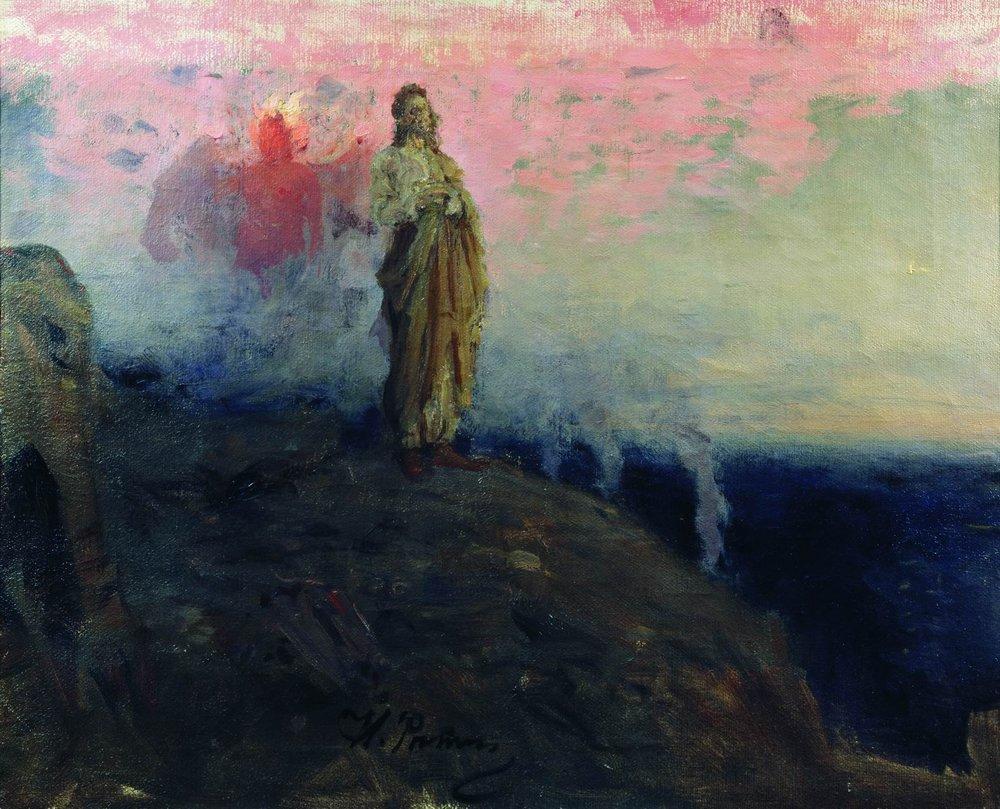
A sermon on Matthew 4:1-11 – First Sunday in Lent Year A
Jesus fasts for forty days before he is tempted. Is it preparation? A boot camp for the soul that Jesus needed to complete before he was ready for his great task? Wilderness experience? Tick. Fasting? Tick. Temptations by the Devil? Tick. Passed with flying colours – you’re ready!
Perhaps there is something to be said for that way of reading the story.
Moses, for instance, had to work as a shepherd for many years before he was ready to be a shepherd to Israel. Elisha had to serve an apprenticeship to Elijah. The Apostle Paul talks about discipleship as a sort of ascesis, a sort of athletic training. The disciples were apprentices to Jesus – after all, that is more or less what the word “disciple” means. And, of course, if you want to be a minister in the Uniting Church you can expect to serve a pretty long formation process – three or four years in college, and more on either side of that.
But I’m not quite satisfied with this. Re-reading this passage, for at least the thousandth time, I was struck by the idea that, at the end of Jesus’ fast, he was famished. Possibly because I was pretty hungry when I was reading it. But perhaps there is a serious point here, rather than just a little detail to bring the scene to life. I’ll come back to this in a minute.
There were, of course, three temptations – another good Biblical number. Turn these stones to bread, throw yourself off the highest point of the temple, become emperor of the whole world.
What are we to make of these temptations? One possible reading is that Jesus doesn’t want to do miracles – that turning stones to bread, making a public demonstration of his identity, or claiming authority over the world is somehow wrong. Cheating, perhaps. Not the sort of thing a humble person would do, not the way of suffering that Jesus is called to.
Again, perhaps there is something in that. But it can’t be that miracles as such are the problem in the story. After all, in Matthew’s account of the gospel, Jesus miraculously feeds large crowds twice. He calms the wind and waves, so that his disciples are struck with fear and they wonder at his extraordinary power. And, at the end of the Gospel, the resurrected Jesus claims “all authority on heaven and earth.”
So we have to conclude that the reason Jesus refuses to do these great signs cannot be that the signs themselves are problematic.
An important clue is that he is not being asked by the Devil to prove that he is God’s son. When he says, “if you are the son of God then do this, that, or the other” the Greek word could be translated “since.” “Since you are God’s son, you could therefore turn this stone into bread – so why not do it?”
The question at issue is not whether Jesus is God’s son or not, but what being God’s son actually means. It is not so much that miracles are problematic, or that he refuses to prove who he is to remove all doubt, but, rather, it is the spirit in which he is being tempted to perform these signs
The point about signs is not that they are evidence for people that Jesus is God’s son, or even for the existence of God. We want to see them like that, but Jesus’ contemporaries had no problem with believing in in what we would call miracles. They had definitely noticed that nature usually behaves in a more or less predictable way, but, unlike contemporary Western society, they did not have a strong division between what we call the “natural” and the “supernatural.” Like almost all cultures, the lived in a universe soaked with God.
No, the point about the miracles of Jesus is not that they are miraculous. After all, as the Pharisees pointed out, miracles could come from a bad source just as much as a good source. Rather, the point of the miracles is that they are communication. That’s why Scripture tends to call them “signs.”
They point somewhere.
That’s why Jesus could not perform miracles in response to the temptation of the Devil. Because if signs don’t point to God, they point to the other bloke.
The signs point to who Jesus is. Yes, they point to Jesus’ power, but they point even more to what stands behind Jesus’ power, or, better, the one who does.
The key point about the temptations is not ultimately about food so much as it is about living by the word that comes from God. It is not about proving his identity to the world by spectacular miracles so much as not putting God to the test. It is not about seizing power: if anyone could solve all the problems of the world just by taking charge, it would be Jesus.
But, then, if Jesus did it as the devil tempted him, would he even be Jesus anymore? Jesus is only Jesus Christ, Jesus the Chosen One, because he is attentive to God. He lives by every word that comes from the mouth of God.
Jesus is only Jesus in relationship to God, and if that relationship were broken, he would not be Jesus – and, hence, ironically unable to solve all the problems in the world. Like Eve and Adam in the garden, the Devil will kind of kept his promise but twisted and perverted to his own ends.
The point about the temptations is that they are not just a particular event in time, nor a particularly striking story. Rather, they point to the choices Jesus made in his whole life, and while I am definitely not saying that Jesus had the tempter in his ear the entire time, the basic choices we see him make in the wilderness are the orientations he has for his entire life.
And while I can’t turn stones to bread, I doubt that if I threw myself off Eureka Tower or Wesley Church God’s angels would do much to help, and no-one is offering me rule of the whole world – the underlying dynamic is the same. The details differ, but the different choices of life-orientation remain the same.
I think there are probably two basic sins for humanity. Pride and despair.
The first of those is to decide as that we can get on perfectly well without God. To decide that God is an affront to our sense of ourselves as self-actualising, independent people who don’t need to bow the knee to anyone. That, given the tools, we can perfectly well build a tower to the sky and knock God off his perch. Or, as the serpent in the story from earlier put it, we can become like God.
The technical name for that is, of course, pride.
The second basic orientation is to think of yourself as not really fully in God’s image. To think that what you do doesn’t matter to God. To think that you are unworthy of God’s love. Let’s call that “worm theology”, and it has sometimes been taught from pulpits to keep people – especially women, the working class, and minorities – in their place.
It may not be as obvious as pride, because it doesn’t lead people to get up in each other’s grills and try to get them to do things. It isn’t self-aggrandizing, trying to be like God.
It might sound a bit odd to call it “sin” because we tend to think of sin as “doing those things that we ought not to do”, and the characteristic of this sin is being passive. But it matches Paul’s description of sin as a sort of slavery from which we need to be freed.
It is the sin of failing to take up the power God has granted you because God does not care about you. But it also kind of lets us off the hook, allows us to give way to a kind of passive inertia in the face of the world and its needs. To think “I don’t matter, so it doesn’t matter what I do.”
I think of it as a kind of despair.
There was once a Rabbi who always carried two stones with him. On one of them was written “you are dust and ashes.” Upon the other was written “the universe was made for you.” We all need both of these statements.
Sometimes some of us need one more than the other.
I tend to be more of a “universe was made for me” sort of a person. I resonate to the temptation that says: if only I had a bigger budget and more authority, then I could finally sort everything out.
This story makes it clear from that this is exactly not what Jesus is on about.
So, back to the idea of being famished.
Jesus didn’t mog[1] the devil – he didn’t best him with his impressive power and holiness. He didn’t defeat him in some sort of gladiatorial combat. Instead, he meets the tempter in weakness and vulnerability. At the end of his rope. When he had nothing left in the tank except for God.
That’s good news for all of us, whether we are “the universe was made for me” type people, or “I am dust and ashes” type people.
For the first type, “the universe was made for me” people, I think this is Good News because it frees us from ourselves. It leads to the immense relief of a Gospel that says: there is a messiah, and it isn’t you. We can relax about our ultimate value and safety, because life with God is a gift that cannot be earned, but can be received.
For the “dust and ashes” people the Good News is that when God wanted to redeem the world, God did it through the simple, the humble, the powerless. God did it through a man hanging on a cross, in what looks an awful lot like defeat.
God became like us, so that we can become like God[2] – and what that means is to be like Jesus who, as the Apostle Paul puts it, did not count equality with God as something to be clung to, but humbled himself and took the form of a servant.
It means that what we do is important not so much because of its world-shaking effects – because if Jesus was just after world shaking effects, he would absolutely have thrown himself off the roof of the temple to the amazement of the waiting crowd. Instead, he said that the most important thing is loving, trusting, following God. And that is possible for all of us, no matter how powerless we feel, or actually are.
What we do and who we are matters to God – which means that it matters as such. The universe was, after all, made for us.
The vulnerability and triumph of Jesus in the wilderness is good news.
Good news for those of us who are proud, because it frees us from the burden of trying to be God ourselves. Good news for those who think they have no value, because Jesus calls us out of ourselves, and all we need is to listen to the words from God’s mouth.
In Jesus Christ, God enters into profound solidarity with the poor and downtrodden and demonstrates that every individual is of profound importance to the God, who loves each of us individually and by name, and has a use and a glorious purpose for each of us, drawing us into the divine three-personed life of God, both now, and forever.
To the holy, blessed and glorious Trinity,
three persons and one God,
be all glory and praise, dominion and power,
now and forever.
Amen.
[1] “a humorous Internet slang term meaning “to outclass,” especially when describing one person as appearing far more attractive than another.” Meriam-Webster
[2] St Athanasius 325 AD “The Son of God became [human] so that [humans] might become God.” But the doctrine of Divinization emphasizes that this is only possible by grace, not by our own efforts.

 Alister Pate